Revolutionizing Control Panel Assembly with Modern Aluminum Frames
In the fast-paced world of industrial automation and manufacturing, efficiency dictates market viability. Every step in the production pipeline must be scrutinized for time waste, resource allocation bottlenecks, and ergonomic hurdles. For decades, traditional panel building has relied on flat steel backplates, a method that demands extensive manual labor including measuring, drilling, tapping, and custom cutting of plastic cable ducts. As labor shortages persist and profit margins tighten, industrial manufacturers are actively seeking alternatives to this archaic workflow.
The integration of advanced aluminum frame systems represents a paradigm shift for engineers, OEMs, and system integrators. By replacing static metal plates with pre-assembled, modular aluminum framing, production floors can dramatically accelerate control panel assembly while improving structural precision and internal component density. This guide explores how transitioning to modern aluminum profiles eliminates traditional manufacturing friction, lowers total project costs, and transforms a traditionally tedious task into a streamlined, repeatable process.
How does pre-assembled framing improve traditional control panel assembly workflows? The answer lies in replacing custom on-site fabrication with precision-engineered, modular components that allow for rapid installation, multi-depth mounting, and significantly cleaner wiring management. Understanding this transformation is key for any technical stakeholder aiming to modernize their manufacturing operations.
The Bottlenecks of Traditional Control Panel Building
To fully appreciate the advantages of modular framing, one must examine the hidden costs of legacy panel building methods. Traditional workflows often begin with a blank sheet of steel that requires meticulous planning to avoid layout mistakes.
- Extensive Manual Preparation: Every terminal block, circuit breaker, and drive must be meticulously measured, marked, drilled, and threaded onto a steel backplate. This manual intervention introduces human error and consumes valuable technician hours.
- Inflexible Component Layouts: Once holes are tapped into a steel plate, modifying the design layout is exceptionally difficult. Relocating a single component often requires patching holes or scrapping the entire backplate.
- Cluttered Wiring Pathways: Traditional builds rely on heavy plastic wire ducts that obstruct airflow, limit component density, and make maintenance tracing frustrating and time-consuming.
- Ergonomic and Physical Strain: Drilling and tapping heavy metal sheets on the shop floor exposes workers to repetitive strain and metal debris, creating unnecessary safety and cleanliness hazards.
These legacy practices create a bottleneck where skilled labor is tied up in basic mechanical fabrication rather than high-value electrical engineering and quality assurance.
How Pre-Assembled Framing Transforms Workflows
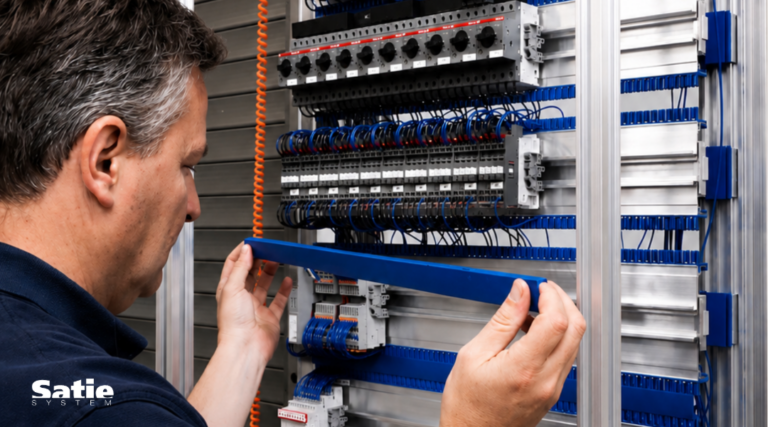
Modern aluminum frame systems solve these operational challenges by shifting the fabrication burden from the shop floor to precision 3D design and pre-assembly. Instead of fastening components directly to a flat plate, technicians use structured aluminum profiles and sliding hardware that allow components to snap or slide into precise positions.
Eliminating Drilling and Tapping
The single most impactful change in modern control panel assembly is the complete elimination of drilling and tapping. Aluminum framing utilizes continuous channels and specialized fasteners that lock components securely into place without damaging the structural integrity of the metal. Technicians can adjust, slide, and reposition components in seconds, turning a rigid mechanical installation into an agile process.
Unlocking Three-Dimensional Space Optimization
Traditional backplates force all equipment onto a single two-dimensional plane, which inevitably leads to oversized enclosures. Aluminum frame systems introduce three-dimensional mounting capabilities. Components can be elevated, layered, and positioned at various depths within the cabinet. This multi-axis arrangement allows manufacturers to optimize enclosure volume by up to 30% to 50%, depending on the specific project requirements, without sacrificing structural or thermal integrity.
Accelerating Mechanical Installation
Because the framework arrives pre-assembled or engineered for rapid modular construction, the mechanical installation phase is compressed drastically. By replacing slow manual preparation with modular locking hardware, operations can achieve up to an 80% reduction in mechanical installation time, depending on the application and shop workflow. This speed allows builders to commission systems faster and scale output to meet rising customer demand.
Engineering Advantages of Aluminum Extrusions
Beyond raw speed, aluminum framing brings distinct engineering benefits that elevate the quality and reliability of the final control panel.
Enhanced Thermal Management
Enclosure internal temperatures are a critical concern for modern electronics. Dense packing on solid steel plates traps heat against the metal surface, creating localized hot spots. In contrast, open aluminum frame architectures promote superior natural airflow around components. Because the frames elevate devices away from solid backplanes and eliminate bulky plastic ducts, heat dissipates more evenly throughout the cabinet volume.
Superior Structural Integrity and Weight Reduction
Steel is undeniably heavy, which increases shipping costs and requires robust handling equipment during assembly. Aluminum provides an optimal strength-to-weight ratio. It offers exceptional rigidity to withstand high-vibration industrial environments while being significantly lighter than steel. This reduction in total panel weight simplifies transport, handling, and final wall-mounting or floor-standing installation.
Streamlining Wiring Management
Wiring is often the most time-consuming phase of panel construction. Poorly organized wiring leads to troubleshooting delays and a cluttered aesthetic that fails to inspire client confidence.
Modular Wiring Channels
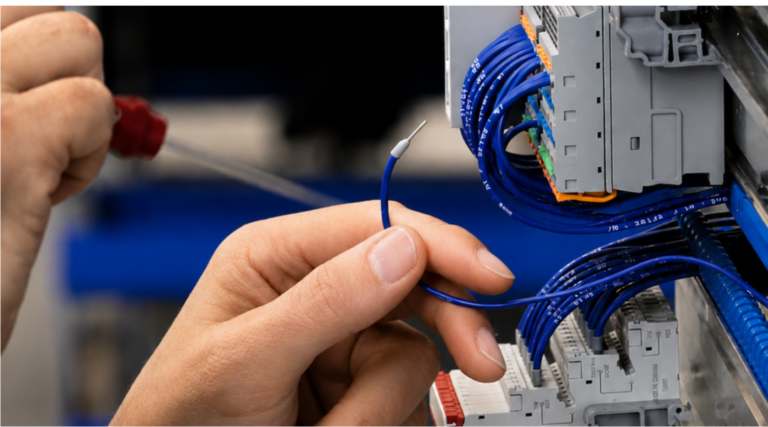
Aluminum framing systems naturally incorporate dedicated routing paths that keep cables separated from power components without relying solely on traditional plastic trunking. This structural organization provides clear visual access to every connection point.
Simplified Maintenance and Serviceability
When a component requires replacement or testing during its operational lifecycle, technicians need unobstructed access. Traditional panels force workers to reach past layers of plastic wiring ducts and densely packed devices. Aluminum systems elevate components and organize conductors along logical paths, making maintenance safer, faster, and much more predictable.
Strategic Impact on Business Operations
Adopting modern framing solutions influences more than just the physical assembly bench. It alters the financial and operational metrics of the entire manufacturing enterprise.
- Labor Optimization: By removing repetitive mechanical tasks, skilled electricians can focus on high-value wiring, testing, and quality control.
- Cost Reduction: Saving approximately 20% in overall build time lowers direct labor costs per unit, increasing profit margins on every project.
- Scalability: Modular designs allow for standardized sub-assemblies, making it easier to train new technicians and scale production capacity during peak demand cycles.
For procurement leads and engineering managers comparing traditional DIY steel builds against pre-engineered aluminum systems, the total cost of ownership clearly favors modular alternatives. To discover how purpose-built framing solutions can transform your shop floor efficiency, visit Satie System to explore our advanced engineering options.
Conclusion
The evolution of industrial manufacturing demands that outdated, labor-intensive practices be replaced with intelligent, efficient solutions. Traditional control panel assembly methods built around flat steel backplates and endless drilling are no longer sufficient to meet modern demands for density, speed, and cost control. By transitioning to modular aluminum frame systems, OEMs and system integrators can eliminate unnecessary mechanical prep work, optimize internal space, and accelerate their build workflows. Embrace the future of panel engineering today and elevate your manufacturing capabilities through practical, precision-engineered innovation.